


Trump Accounts Explained - What Parents and Grandparents Should Know
Andrea McClelland, CFP®
Parents and grandparents have a variety of ways to save for the next generation. Depending on the goal, options include a 529 plan for education, a custodial account, or helping fund a Roth IRA.
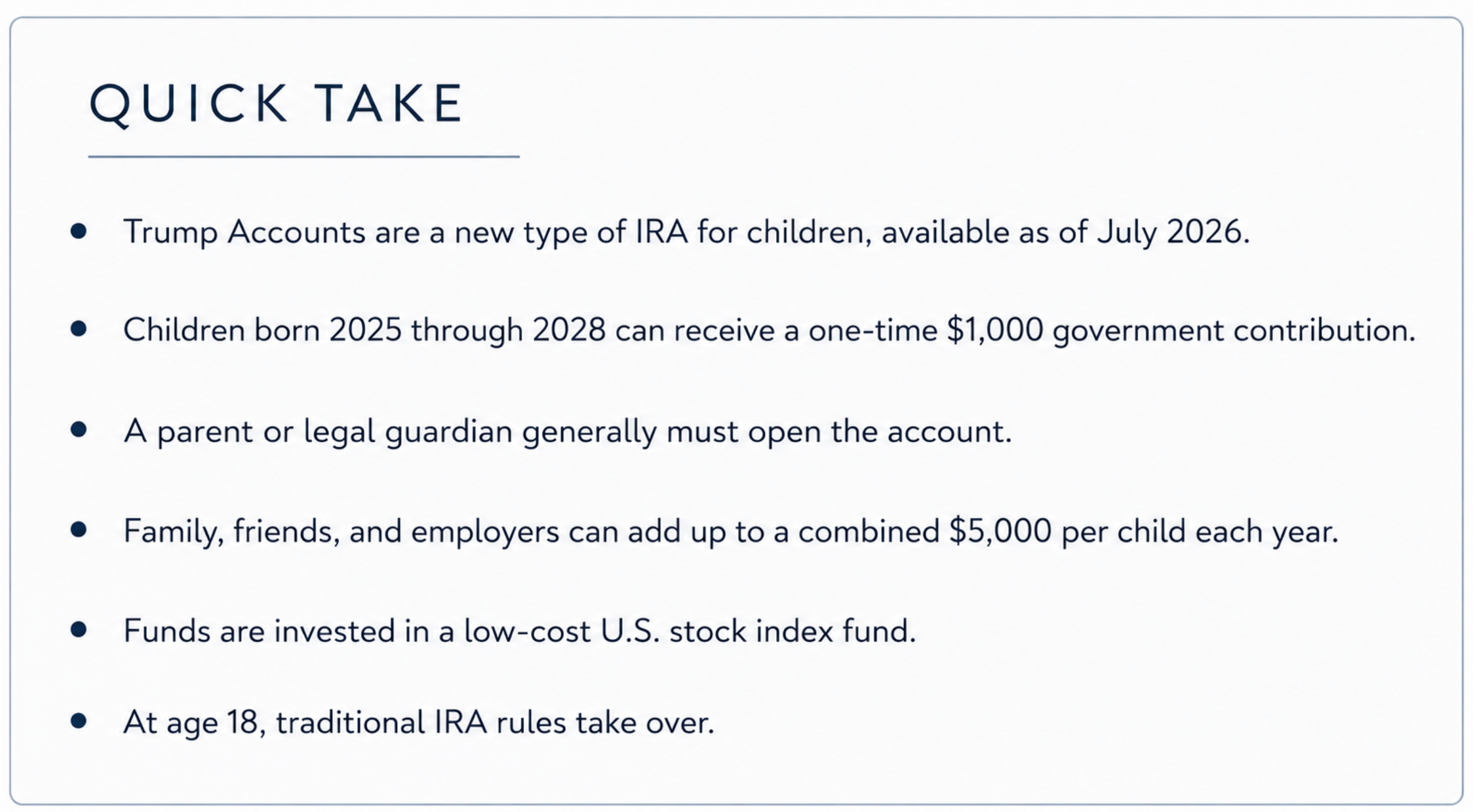
As of July 2026, there is another option: the Trump Account (also called a 530A account), a new type of retirement account created specifically for children. The rules are unusual and are still being refined, but two features stand out: a $1,000 government contribution available for U.S. citizens born between 2025 and 2028, and the ability to start retirement savings long before a child could otherwise contribute to an IRA. Here is what to know.
What is a Trump Account?
A Trump Account is a new type of traditional IRA opened for a child with a valid Social Security number before the year the child turns 18. Each child can have only one. Unlike a Traditional or Roth IRA, contributions during the account’s pre-18 “growth period” do not require the child to have earned income.
Parents, grandparents, relatives, friends, and employers can all contribute, up to a combined $5,000 per child per year for 2026 and 2027.1 The $1,000 government contribution described below, certain other government or charitable contributions, and qualified rollovers do not count toward that limit.
The $1,000 Federal contribution for children born 2025 through 2028
For U.S. citizen children born between January 1, 2025 and December 31, 2028, the U.S. Treasury will make a one-time $1,000 “pilot program” contribution once the required election is filed. No other contributions are required to receive the $1,000, and it does not count toward the $5,000 annual limit. For an eligible child or grandchild, this is often the simplest reason to open an account, even if other account types better suit savings goals.
A head start on retirement savings
The second notable feature is the chance to invest for retirement before a child has earned income. Normally, a child cannot fund a Traditional or Roth IRA until they have income from a job or self-employment income. Trump Accounts waive that requirement during the growth period, so families can start retirement savings when a child is very young, giving those dollars more time to grow.
Opening and funding an account for a child or grandchild
Unlike a 529 or custodial account, a grandparent generally cannot open a Trump Account for a grandchild; in most families, a parent or legal guardian must make the initial election.2 The election is filed on Form 4547, which may be submitted via the filer’s IRS account3, with their tax return, or via the official TrumpAccounts app, available through trumpaccounts.gov. Form 4547 is also used to claim the $1,000 contribution if the child qualifies.4 After the form is processed, the account must be activated. For more information on the account opening process, see the “Answers” section at trumpaccounts.gov.
Once the account is active, parents, grandparents and others can contribute. A grandparent does not need to manage it to help fund it. Note that all contributions from individuals count toward the same $5,000 annual limit.
Individual contributions are gifts to the child and are not tax-deductible. For 2026, the annual gift-tax exclusion is $19,000 per donor, per recipient, and the IRS has provided a safe harbor treating qualifying contributions as eligible for the annual exclusion.
How is the money invested?
During childhood, investments are limited to low-cost mutual funds or ETFs that track broad U.S. stock indexes, with no leverage and annual fees of 0.10% or less. For now, all contributions go into an S&P 500 index fund. Several additional low-cost index funds are expected to be introduced as available options in the coming months.
The tax treatment deserves attention
This is where Trump Accounts get more complicated. During the growth period, money generally cannot be withdrawn. When the child turns 18, the account becomes a Traditional IRA and ordinary IRA rules apply – withdrawals will be subject to income tax and, if applicable, a 10% penalty on early distributions.
Individual contributions are after-tax, while the $1,000 government contribution and certain employer or charitable contributions are not, so an account can hold a mix of pre-tax and after-tax money plus earnings. The custodian handles recordkeeping through age 18; after that, the child (with help from family or a tax preparer) takes on this reporting responsibility.
At age 18, once the account becomes subject to traditional IRA rules, the child may choose to convert some or all of it to a Roth IRA. Depending on the child’s income at the time, a conversion could potentially occur at a relatively low tax rate. But a Trump Account is not a Roth IRA: distributions and conversions may be taxable to the extent they include pre-tax amounts and earnings.
So, should you fund one?
Trump Accounts are not a replacement for the strategies parents and grandparents may already use, but they are worth a look, especially for children born 2025 through 2028, or for families that want to kickstart retirement savings at a young age. Where to direct additional gifts depends on the goal: education savings, flexible support, and long-term retirement savings each point to a different account type. For families with an eligible child or grandchild, it may help to look at how a Trump Account fits alongside what you already have. We’re glad to help you think it through.
- The $5,000 cap adjusts for inflation after 2027. Employers can contribute up to $2,500 per child (within the $5,000 limit); further guidance on employer and possible pre-tax employee contributions is expected.
- Who may open the account follows a priority order: legal guardian, then parent, then adult sibling, then grandparent. A grandparent can act only if no one higher on the list is available.
- If the form filer does not already have an IRS account, they must create one to file the form directly through IRS.gov.
- To claim the $1,000, the person filing Form 4547 generally must expect to claim the child as a dependent for that tax year.
This article is intended for educational and informational purposes only and does not constitute specific tax, legal, investment, or financial advice. The information provided is derived from sources believed to be reliable and is based on current tax laws and regulations as of the date of publication, which are subject to change. Aegis Wealth Management, LLC is not a law firm or accounting firm and does not give legal, accounting, or tax advice. Readers should consult with a qualified legal and/or tax professional to understand how these laws and regulations may apply to their unique circumstances. This material is not intended to be relied upon to avoid tax penalties under U.S. federal tax law. Past performance does not guarantee future results. All investing involves risk, including risk of loss.